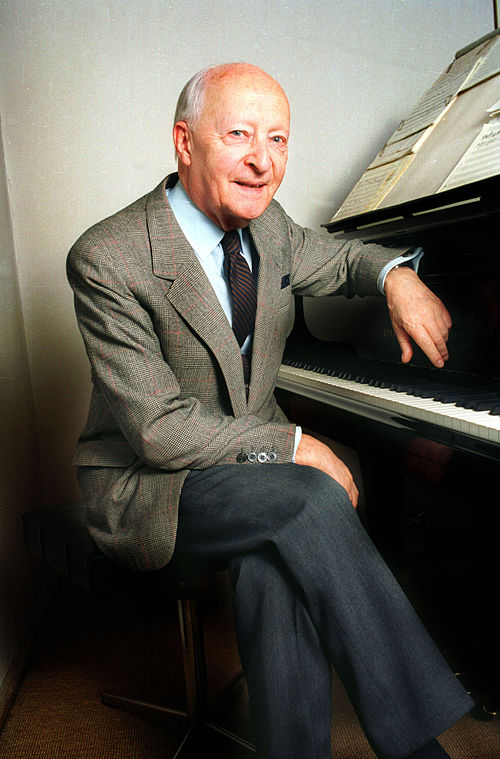
Witold Lutosławski
Witold Lutosławski (1913–1994) was a Polish composer and conductor renowned for his contributions to twentieth-century music, particularly in orchestral and chamber composition. His work is distinguished by its synthesis of modernist techniques, including controlled aleatoricism, with expressive lyricism and structural clarity. Lutosławski is widely regarded as one of the most significant European composers of the postwar era, influencing both Polish and international musical developments.
Early Life and Education
Witold Lutosławski was born on January 25, 1913, in Warsaw, Poland, into a musically prominent family. He studied piano and composition at the Warsaw Conservatory under Kazimierz Sikorski and later took private lessons with various Polish composers. His early exposure to folk music and European modernist trends, combined with his formal training, laid the foundation for a style that balanced innovation with accessibility.
During World War II, Lutosławski’s musical activities were restricted under Nazi occupation, though he continued to study, perform, and arrange works for small ensembles. These experiences contributed to his development as both a composer and conductor, deepening his engagement with Polish musical traditions and fostering resilience in his creative approach.
Career
Lutosławski’s postwar career marked his emergence as a leading figure in European contemporary music. Early works, such as Concerto for Orchestra (1950–54) and Musique funèbre (1954), demonstrate his command of orchestral texture, contrapuntal technique, and harmonic innovation. Over time, he developed a distinctive approach to controlled aleatoricism—a method in which performers are given certain freedoms within a rigorously structured compositional framework—allowing for unpredictability without sacrificing formal coherence.
He served as a conductor, teacher, and advocate for contemporary music in Poland and abroad, influencing younger generations of composers and helping to establish modernist traditions in postwar Polish music. Lutosławski received numerous international commissions and awards, cementing his status as a leading European composer.
Major Works
Orchestral Music
Lutosławski’s orchestral output is central to his reputation. Key works include:
Concerto for Orchestra (1950–54), demonstrating virtuosic orchestration and a synthesis of modernist techniques with folk-inspired elements.
Symphony No. 2 (1965–67), employing controlled aleatoricism and exploring complex textural layering.
Chain 1 and Chain 2 (1983, 1985), which exemplify his mature approach to formal structure and stochastic processes.
Symphony No. 4 (1988–92), combining lyricism, rhythmic vitality, and sophisticated orchestral color.
Chamber and Solo Works
Lutosławski’s chamber music is characterized by clarity, contrapuntal richness, and timbral exploration. Works such as String Quartet (1964) and Piano Variations (1958–59) reflect his interest in motivic development, textural contrast, and harmonic innovation. Solo pieces, including Chain for Cello and Orchestra (1990), reveal a meticulous attention to instrumental idiom and expressive potential.
Vocal and Choral Music
Lutosławski composed vocal and choral works that often integrate Polish poetry and sacred texts. Paroles tissées (1965) and Les Espaces du sommeil (1975–76) exemplify his approach to text setting, balancing expressive immediacy with structural precision and refined harmonic language.
Musical Style
Lutosławski’s style is characterized by:
Controlled aleatoricism: introducing performer independence within highly structured frameworks.
Orchestral color and texture: innovative instrumentation and dynamic layering to create depth and contrast.
Formal clarity: careful organization of musical material, often integrating motivic transformation and developmental processes.
Integration of tradition and modernism: blending folk elements, lyricism, and European avant-garde techniques.
Rhythmic and harmonic innovation: frequent use of asymmetry, polymeter, and nontraditional harmonic structures.
His music demonstrates a balance between intellectual rigor and expressive immediacy, making his work both challenging and emotionally compelling.
Influence and Legacy
Witold Lutosławski is widely recognized as a central figure in twentieth-century European music. His innovations in orchestral and chamber composition, particularly his use of controlled aleatoricism, influenced composers internationally and shaped the trajectory of contemporary Polish music.
Lutosławski passed away on February 7, 1994, in Warsaw. His legacy endures through his extensive body of work, which continues to be performed worldwide and is celebrated for its structural ingenuity, expressive depth, and contribution to modernist music.