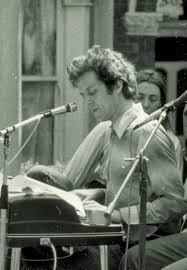
Cornelius Cardew
Cornelius Cardew (1936–1981) was an English composer, pianist, and political activist, notable for his contributions to experimental music, graphic notation, and collective improvisation. His work spans avant-garde composition, indeterminacy, and politically engaged music, reflecting a commitment to both musical innovation and social activism. Cardew was a central figure in the post-war experimental music scene in Europe and influenced subsequent generations of composers and improvisers.
Early Life and Education
Cornelius Cardew was born on May 7, 1936, in Winchcombe, Gloucestershire, England. He studied composition at the Royal Academy of Music in London before receiving a scholarship to study with Karlheinz Stockhausen at the Cologne Courses for New Music in Germany. He later studied with Pierre Boulez at the Darmstadt Summer Courses, experiences that exposed him to serialism, European avant-garde practices, and emerging experimental approaches to music.
Career
Early Experimental Work
Cardew’s early compositions demonstrate a synthesis of European modernist techniques and exploratory approaches to sound and form. Works from this period include Structuralist pieces and serial compositions that reflect his engagement with post-war avant-garde traditions. Influenced by Stockhausen, Boulez, and the New York School, Cardew quickly developed an interest in indeterminacy, graphic notation, and open-form composition.
Scratch Orchestra and Graphic Scores
In 1969, Cardew co-founded the Scratch Orchestra, a collective of professional musicians, amateurs, and non-musicians dedicated to experimental and participatory music-making. The Scratch Orchestra emphasized collective improvisation, open scores, and inclusivity, blurring distinctions between performer and audience. This ensemble became a platform for exploring unconventional notation, performance practice, and political engagement through music.
During this period, Cardew produced influential graphic scores, including Treatise (1963–1967), a large-scale work consisting of 193 pages of abstract graphical symbols. Treatise is non-prescriptive, allowing performers interpretive freedom, and exemplifies his interest in indeterminacy, collaborative performance, and the conceptual expansion of musical notation.
Political Engagement and Later Work
From the mid-1970s, Cardew increasingly aligned his music with Marxist politics and social activism. He composed works intended for collective performance in community and political contexts, often incorporating revolutionary texts and accessible musical language. Pieces such as The Great Learning (1968–1971) combined avant-garde techniques with participatory elements, emphasizing the social and educational dimensions of music.
Cardew’s later compositions and writings reflect a belief that music should serve collective and political purposes, moving beyond aesthetic autonomy to engage with issues of class, ideology, and social practice.
Improvisation and Collaborative Practice
Throughout his career, Cardew emphasized improvisation as a central musical practice. He collaborated with a wide range of performers, ensembles, and experimental artists, exploring extended techniques, real-time composition, and collective sound-making. His improvisational philosophy influenced European experimental music and contemporary free improvisation.
Musical Style and Aesthetic
Cardew’s musical style evolved significantly over his career but is characterized by:
Indeterminacy and graphic notation, allowing performer interpretation and open-ended performance.
Minimalist and process-oriented approaches, emphasizing repetition, texture, and sonic exploration.
Integration of avant-garde and popular forms, particularly in politically motivated works.
Collective improvisation and participatory performance, challenging traditional hierarchies between composer, performer, and audience.
Political and social engagement, emphasizing music as a tool for community building and ideological expression.
Cardew’s work embodies a commitment to both conceptual rigor and social responsibility, reflecting a unique synthesis of experimentalism and activism.
Influence and Legacy
Cornelius Cardew is regarded as a pivotal figure in post-war British experimental music and a leading advocate for socially engaged composition. His work with the Scratch Orchestra, graphic scores, and politically motivated compositions influenced European experimental composers, improvisers, and activist musicians.
Cardew’s integration of improvisation, graphic notation, and collective performance continues to inform contemporary practices in experimental music, participatory art, and socially oriented composition. Despite his untimely death in 1981, his contributions remain central to discussions of avant-garde music, the role of the composer in society, and the intersection of artistic innovation and political commitment.