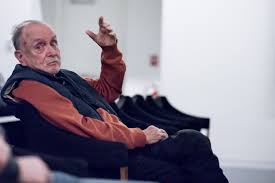
Alvin Lucier
Alvin Lucier (1931–2021) was an American composer and sound artist renowned for his experimental approach to music, particularly his exploration of acoustic phenomena, resonance, and the physical properties of sound. A central figure in the post-war avant-garde and the New York experimental music scene, Lucier’s work spans performance, installation, and composition, often emphasizing the relationship between sound, space, and listener perception. His contributions have had a profound influence on experimental music, sound art, and acoustic research.
Early Life and Education
Alvin Augustus Lucier Jr. was born on May 14, 1931, in Nashua, New Hampshire, United States. He studied music at Yale University, where he developed a foundation in classical and contemporary composition, and later pursued studies at Brandeis University. His early exposure to both traditional music and experimental techniques shaped his interest in sonic phenomena and the interplay between acoustics, perception, and composition.
Career
Experimental Music and the New York School
Lucier was closely associated with the New York School of composers, collaborating with figures such as John Cage, David Tudor, and Steve Reich. He served as an instructor at Wesleyan University in Connecticut, where he influenced a generation of composers and experimental musicians. Lucier’s teaching and research emphasized exploratory approaches to sound, encouraging students to investigate the physics of musical instruments and the environment in which music is performed.
Compositional Focus
Lucier’s compositions often foreground acoustic phenomena over traditional melody, harmony, or rhythm. He explored resonance, interference, and spatialization through works that examine how sound interacts with physical space, human perception, and electronic amplification. Many of his pieces involve the use of sine waves, feedback loops, live electronics, and the natural resonances of performance spaces.
Major Works
I Am Sitting in a Room (1969) is perhaps Lucier’s most iconic work. In this piece, he records spoken text and plays it back repeatedly in the room, allowing the natural resonant frequencies of the space to transform the recording into pure sound waves. The work exemplifies Lucier’s focus on acoustic phenomena and the passage of time in sonic perception.
Music on a Long Thin Wire (1977) uses an amplified wire to produce evolving tones, demonstrating his interest in physical properties of sound sources and feedback processes.
Clocker (1978–1980) and Vespers (1968) further explore resonance, phase interactions, and the perceptual effects of sustained sound.
Numerous installations and site-specific works, including pieces designed for unconventional performance spaces, illustrate his commitment to engaging audiences with the acoustical properties of the environment.
Musical Style and Aesthetic
Lucier’s style is characterized by:
Exploration of acoustic and electronic phenomena, often prioritizing sonic behavior over conventional musical structures.
Minimalist and process-based approaches, with gradual transformations and long durations that reveal subtle shifts in timbre and resonance.
Integration of space and environment, treating performance spaces as active components of the composition.
Focus on perception, emphasizing how human listeners experience sound over time.
Interdisciplinary engagement, bridging music, physics, and technology.
Lucier’s work exemplifies a rigorous inquiry into sound itself, often transforming ordinary acoustic phenomena into perceptual and conceptual experiences.
Influence and Legacy
Alvin Lucier is recognized as one of the most influential figures in experimental music and sound art. His work has shaped contemporary approaches to acoustic research, site-specific composition, and electronic music, inspiring composers, sound artists, and researchers interested in the intersections of music, physics, and perceptual experience.
Lucier’s compositions continue to be performed internationally, studied in music and sound art programs, and cited as seminal examples of the exploration of sound as a physical, spatial, and perceptual phenomenon. His contributions have established him as a pivotal figure in the evolution of experimental music in the twentieth and twenty-first centuries.