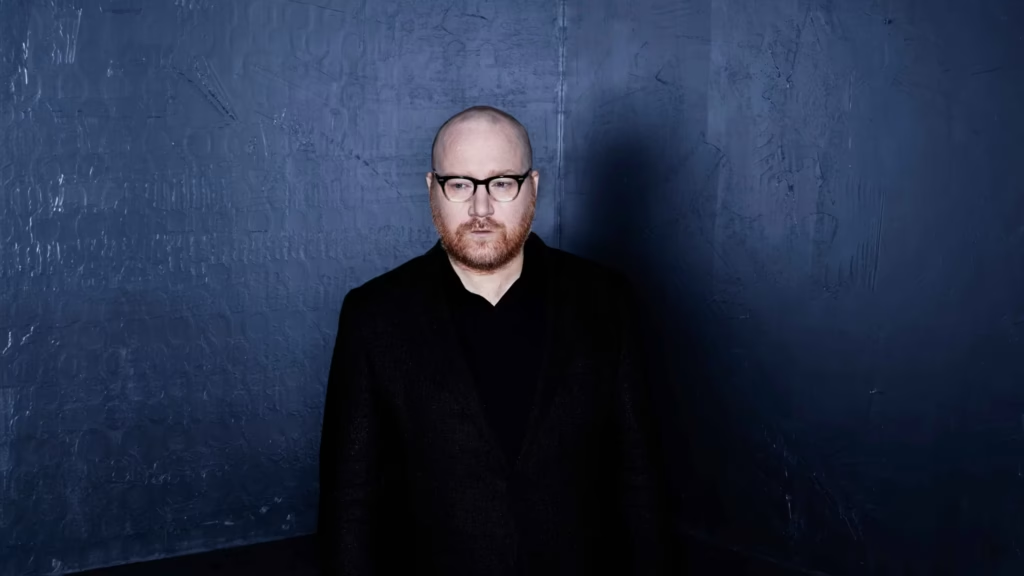
Jóhann Jóhannsson
Jóhann Jóhannsson (1969–2018) was an Icelandic composer, producer, and sound artist recognized for his distinctive fusion of classical instrumentation, electronic timbres, and conceptual narrative structures. Emerging as a central figure in the early twenty-first-century neoclassical and experimental music scenes, he produced a body of work notable for its atmospheric restraint, structural clarity, and deep engagement with historical, technological, and philosophical themes. His concert works, film scores, and multimedia projects have been widely acclaimed for their ability to evoke emotional nuance through minimal means, placing him among the most influential composers of his generation.
Early Life and Education
Jóhannsson was born on September 19, 1969, in Reykjavík, Iceland. He studied literature and languages at the University of Iceland, and while not formally trained in composition, he became active in the Icelandic alternative-music community during the 1990s. He participated in several experimental rock and electronic ensembles, experiences that informed his later interest in hybrid musical structures and cross-genre collaborations. His background in literature shaped his conceptual approach to composition, often grounding his works in narrative or historical frameworks.
Career
Jóhannsson began to gain international recognition in the early 2000s with solo albums that explored the interplay of chamber ensembles, electronic processing, and field recordings. His work often centers on recurring melodic figures, slow harmonic pacing, and a refined palette of instrumental colors. Over the course of his career, he released numerous influential recordings, composed for major international films, and created interdisciplinary projects involving installation art, documentary methods, and archival research.
Relocating periodically between Reykjavík, Copenhagen, and Berlin, Jóhannsson worked with diverse collaborators across the fields of classical music, electronic production, and visual media. His career advanced rapidly during the 2010s as he became a sought-after composer for film directors interested in atmospheric, introspective sound worlds.
Major Works
Solo Albums
Jóhannsson’s discography includes several landmark recordings that established his reputation:
Englabörn (2002), built around a string ensemble, percussion, and subtle electronic textures, demonstrating his early interest in miniature forms and emotionally concentrated motifs.
IBM 1401, A User’s Manual (2006), a concept album integrating archival recordings of an early computer system with orchestral writing, reflecting his fascination with obsolete technologies and the poetics of mechanization.
Fordlandia (2008), inspired by Henry Ford’s failed Amazonian industrial colony, combining large-scale string writing with electronic and historical materials.
Orphée (2016), a meditative work drawing upon mythic and literary sources, blending solo instruments, electronics, and choir in a restrained, elegiac idiom.
These works illustrate his engagement with historical narrative, archival sound, and the tension between mechanical repetition and human expression.
Film Scores
Jóhannsson gained significant global recognition for his film work, composing scores noted for their textural subtlety and psychological depth. Notable examples include:
The Theory of Everything (2014), whose lyrical orchestral writing contributed to the film’s emotional impact and earned him a Golden Globe Award.
Sicario (2015), featuring ominous bass textures, percussive pulses, and dark harmonic fields that articulate the film’s atmosphere of tension and moral ambiguity.
Arrival (2016), blending extended vocal techniques, microtonal writing, and electronic processing to complement the film’s themes of language, temporality, and human contact.
Mandy (2018), a posthumously released score known for its dense, distorted textures and hybrid industrial-ambient sonorities.
His work in cinema reshaped expectations for contemporary film scoring, bringing avant-garde techniques and minimalistic aesthetics into mainstream visibility.
Interdisciplinary and Multimedia Projects
Jóhannsson also pursued projects that combined music with documentary footage, text, and installation art. Among these, Last and First Men, completed posthumously and based on Olaf Stapledon’s speculative novel, stands out as a major achievement. The project integrates orchestral writing, electronic sound design, and black-and-white film footage to create an expansive meditation on civilization, memory, and extinction.
Musical Style
Jóhannsson’s style is characterized by:
A fusion of acoustic and electronic elements, often deploying strings, brass, organ, and voice alongside analog synthesizers and processed field recordings.
Minimalist structures, with slow harmonic motion, repeated figures, and an emphasis on gradual transformation.
A narrative and conceptual orientation, frequently drawing on historical events, technological relics, or literary sources.
A focus on timbre and atmosphere, prioritizing sonic texture over virtuosic display.
An elegiac, introspective tone, maintaining emotional immediacy while avoiding overt sentimentality.
His works often explore the intersection of human vulnerability and technological modernity, using sound to evoke memory, decay, and the passage of time.
Influence and Legacy
Jóhann Jóhannsson is widely regarded as a pivotal figure in the development of early twenty-first-century neoclassical and experimental composition. His ability to merge classical orchestration with electronic sensibilities helped shape the aesthetics of contemporary ambient and film music. His recordings remain influential among composers, sound designers, and interdisciplinary artists seeking to bridge conceptual rigor with expressive clarity.
Following his death on February 9, 2018, in Berlin, tributes highlighted the originality and emotional resonance of his work, cementing his status as one of the most distinctive musical voices of his generation. His compositions, scores, and multimedia projects continue to be performed and studied internationally, ensuring his enduring presence in the landscape of contemporary music.