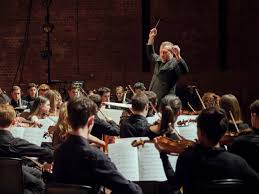
Thomas Adès
Thomas Adès (b. 1971) is a British composer, conductor, and pianist widely recognized as one of the leading figures in contemporary classical music. Renowned for his inventive harmonic language, complex textures, and dramatic sensibility, Adès has produced a diverse body of work encompassing orchestral, operatic, chamber, and vocal music. His compositions are noted for their intellectual rigor, expressive depth, and synthesis of historical and contemporary musical idioms.
Early Life and Education
Thomas Adès was born on March 1, 1971, in London, England. He displayed prodigious musical talent from an early age, studying piano, violin, and composition. Adès attended Highgate School and later the Guildhall School of Music and Drama, where he pursued formal studies in composition. He also studied under composers such as Robert Saxton and Simon Bainbridge, developing an early compositional style that combined traditional European forms with modern harmonic and rhythmic innovation.
Career
Adès has established an international reputation as a composer and conductor, with his works performed by leading orchestras, ensembles, and opera companies worldwide, including the Berlin Philharmonic, the Royal Concertgebouw Orchestra, the London Symphony Orchestra, and the Metropolitan Opera. In addition to composing, he has served as a conductor, frequently directing performances of his own works as well as contemporary and historical repertoire.
His career is particularly distinguished by his contributions to opera, where he integrates complex orchestration, dramatic narrative, and innovative staging. Adès has also composed extensively for orchestra, chamber ensembles, solo instruments, and vocal forces, often exploring the interplay of texture, timbre, and rhythm.
Major Works
Opera
Adès’s operatic works are acclaimed for their dramatic intensity, intricate orchestration, and imaginative narrative:
Powder Her Face (1995) explores the life of the Duchess of Argyll through provocative theatricality and innovative harmonic language.
The Tempest (2004), based on Shakespeare’s play, combines lush orchestration with contemporary vocal techniques and complex structural design.
The Exterminating Angel (2016), inspired by Luis Buñuel’s film, demonstrates his mastery of orchestral color, dramatic pacing, and surrealistic narrative.
Orchestral Music
Adès’s orchestral compositions are characterized by their textural richness, rhythmic intricacy, and harmonic innovation:
Asyla (1997) features a large orchestral palette and explores contrasting sonic worlds, from ecstatic dance to brooding introspection.
Tevot (2007) combines structural rigor with lyrical passages, reflecting his interest in narrative and architectural forms in music.
Totentanz (2013), a collaboration with baritone Bryn Terfel, blends orchestral power with vocal virtuosity in a meditation on death.
Chamber and Solo Music
Adès has composed extensively for chamber ensembles and solo instruments, often exploring complex rhythmic structures and timbral experimentation:
Arcadiana (1994) for string quartet combines historical references with contemporary harmonic and rhythmic techniques.
Lieux retrouvés (2016) for solo piano exemplifies his lyrical and virtuosic writing, incorporating unconventional textures and sonorities.
In Seven Days (2008), a piano and percussion work, reflects his interest in rhythm, timbre, and minimalism-infused modernism.
Vocal and Choral Music
Adès’s vocal works demonstrate expressive depth and innovative textural treatment:
Totentanz (2013), for baritone, chorus, and orchestra, combines medieval and modern influences.
American Football (1998), for vocal ensemble, showcases his intricate counterpoint and rhythmic interplay.
Musical Style
Thomas Adès’s music is characterized by:
Harmonic innovation: complex tonal and atonal structures that create tension and lyricism.
Textural richness: dense, layered orchestration and chamber textures.
Rhythmic complexity: polyrhythms, irregular meters, and sophisticated temporal structures.
Dramatic sensibility: narrative-driven compositions, particularly in opera.
Integration of historical and contemporary idioms: references to past musical styles within a modern framework.
Adès’s style balances intellectual rigor with emotional immediacy, appealing to both performers and audiences through its technical sophistication and expressive clarity.
Influence and Legacy
Thomas Adès is regarded as one of the most influential contemporary composers of his generation, with a profound impact on opera, orchestral, and chamber music. His compositions have expanded the expressive and structural possibilities of contemporary classical music, inspiring a generation of composers, performers, and conductors.
Through his work as a composer and conductor, Adès has contributed significantly to the development of twenty-first-century classical music, combining innovation, narrative insight, and technical mastery to shape a distinctive artistic legacy.