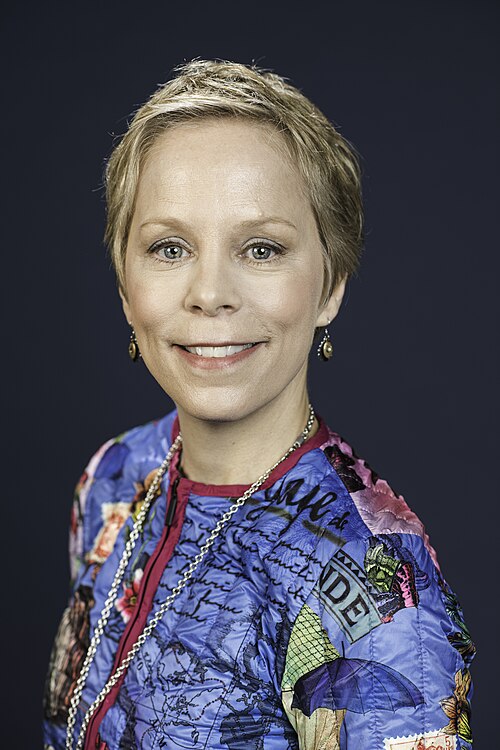
Augusta Read Thomas
Augusta Read Thomas (b. 1964) is an American composer renowned for her contributions to contemporary classical music, particularly in orchestral, chamber, and vocal works. Her compositions are characterized by vibrant coloristic orchestration, intricate rhythmic structures, and a commitment to expressive and architectural clarity, establishing her as a leading figure in twenty-first-century American music.
Early Life and Education
Augusta Read Thomas was born on April 24, 1964, in Glen Cove, New York. She studied composition at Harvard University under the guidance of Bernard Rands and later at Yale University with Jacob Druckman. Additional studies included masterclasses and private instruction with notable composers such as Olivier Messiaen, György Ligeti, and Luciano Berio. These experiences exposed her to diverse compositional traditions and avant-garde techniques, shaping her distinctive voice that balances complexity with lyrical and structural clarity.
Career
Thomas’s career encompasses a wide range of compositions, including works for orchestra, chamber ensembles, solo instruments, and voice. She has held prominent academic positions, including the Irving Gilmore Professorship at the University of Chicago and serving as Composer-in-Residence with several orchestras. Her works have been commissioned and performed by major ensembles such as the Chicago Symphony Orchestra, the Boston Symphony Orchestra, and the New York Philharmonic.
Thomas is also recognized for her advocacy of contemporary music, serving on advisory boards, participating in international music festivals, and mentoring emerging composers. Her contributions extend to championing the integration of new music into educational and performance contexts.
Major Works
Orchestral Music
Thomas’s orchestral works are celebrated for their coloristic richness, rhythmic energy, and formal sophistication. Notable works include:
Astral Canticle (1999), a composition for soprano and orchestra that exemplifies her lyrical and harmonic ingenuity.
Sun Dance (2006), an energetic orchestral piece emphasizing rhythmic drive and vibrant orchestral textures.
Carillon Sky (2016), showcasing her characteristic layering of sound and intricate textural interplay.
Chamber and Solo Music
Her chamber music demonstrates attention to timbral interplay, rhythmic nuance, and formal clarity. Works such as Eos String Quartet (2004) and Hyperion (1995) highlight her inventive use of instrumental color and dialogue. Solo compositions, including Clair de Lune for solo piano, explore expressive range and technical sophistication.
Vocal and Choral Music
Thomas has composed extensively for voice and chorus, integrating poetry and textual inspiration into her musical language. Works like Resounding Earth (2001) and Acrostic Song (2010) illustrate her ability to balance lyrical expression with intricate harmonic and rhythmic structures.
Musical Style
Augusta Read Thomas’s music is characterized by:
Coloristic orchestration: imaginative use of timbre, instrumental layering, and spatial effects.
Rhythmic complexity: dynamic and often asymmetrical rhythmic structures driving musical development.
Expressive lyricism: melodic and harmonic gestures that communicate emotive and narrative content.
Structural clarity: carefully articulated forms that combine modernist sophistication with perceptible coherence.
Integration of contemporary techniques: synthesis of extended instrumental methods, spectral influences, and innovative textures within a tonal or modal framework.
Her compositional approach emphasizes the perceptual and emotional experience of music, blending intellectual rigor with accessibility and expressive immediacy.
Influence and Legacy
Augusta Read Thomas is recognized as a leading American composer whose works have enriched the contemporary repertoire for orchestra, chamber ensemble, and voice. Her commitment to education, mentorship, and advocacy for new music has influenced a generation of composers and performers.
Through her distinctive synthesis of color, rhythm, and structure, Thomas has made a lasting impact on contemporary classical music, securing her place as a central figure in American compositional practice.