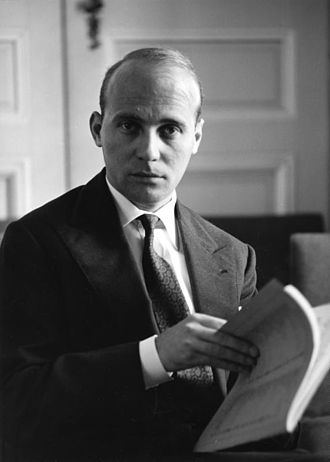
Hans Werner Henze
Hans Werner Henze (1926–2012) was a German composer known for his prolific output across opera, orchestral, chamber, and vocal music, and for his engagement with both avant-garde and traditional musical forms. His work combines modernist techniques, lyrical expression, and socio-political engagement, making him one of the most significant German composers of the twentieth century.
Early Life and Education
Henze was born on July 1, 1926, in Gütersloh, Germany. He displayed musical aptitude from a young age, studying piano and composition before attending the Cologne Conservatory, where he received training in theory, orchestration, and performance. His early exposure to German and European musical traditions, combined with contemporary influences, shaped a compositional voice that integrated modernist experimentation with lyrical and dramatic sensibilities.
Career
Henze’s career spanned more than six decades and was marked by stylistic diversity, encompassing serialism, twelve-tone techniques, and tonally centered works. After World War II, he gained recognition for his operas and orchestral works, reflecting both postwar modernist tendencies and a renewed engagement with humanist themes. Henze lived for much of his life in Italy, where he became involved in political and cultural movements that influenced his music.
Henze held various teaching positions and engaged in cultural advocacy, championing contemporary music and mentoring younger composers. His music often reflects socio-political concerns, addressing themes of injustice, exile, and human rights.
Major Works
Operas
Henze’s operatic output is central to his legacy, characterized by dramatic intensity, lyrical invention, and a fusion of modernist and traditional idioms. Key works include:
Boulevard Solitude (1951), an adaptation of the Manon Lescaut story, demonstrating early engagement with serialism and expressive lyricism.
The Bassarids (1965), which explores Greek tragedy through complex harmonic and orchestral language.
Elegy for Young Lovers (1961), reflecting his interest in psychological depth and poetic narrative.
Orchestral Music
Henze composed extensively for orchestra, often combining rhythmic vitality, lyricism, and innovative orchestration. Notable works include Symphony No. 1 (1947) and Symphony No. 9 (1997), as well as orchestral suites drawn from his operas and ballets. Works such as Royal Winter Music (1976) for solo guitar demonstrate his capacity for virtuosic writing and intricate thematic development.
Chamber and Solo Music
Henze’s chamber works exhibit contrapuntal sophistication, timbral inventiveness, and expressive directness. Piano Sonata No. 1 (1947) and Quartet No. 4 (1975) exemplify his approach to motivic development, formal clarity, and harmonic exploration. Solo works, including pieces for guitar and piano, highlight his attention to instrumental idiom and expressive nuance.
Vocal Music
Henze wrote extensively for voice, setting poetry in German, English, Italian, and Spanish. Works such as Sechs Gesänge aus dem Spanischen (1963) illustrate his sensitivity to text, melodic line, and harmonic color. His vocal works frequently address political or philosophical themes, integrating lyrical and modernist elements.
Musical Style
Henze’s music is characterized by:
Stylistic plurality: integration of serialism, modernist techniques, and tonally centered passages.
Expressive lyricism: emphasis on melodic and emotional content, often juxtaposed with structural complexity.
Orchestral and instrumental color: inventive instrumentation and textural experimentation.
Socio-political engagement: works often reflect contemporary issues, exile, or philosophical themes.
Formal innovation: creative approaches to rhythm, structure, and motivic development, balancing tradition and experimentation.
Henze’s music demonstrates an ongoing dialogue between avant-garde experimentation and humanistic expressiveness, making his works intellectually compelling and emotionally resonant.
Influence and Legacy
Hans Werner Henze is regarded as a central figure in twentieth-century German music, influencing both European and international composers. His integration of modernist techniques with dramatic, lyrical, and socially conscious content expanded the expressive potential of contemporary music.
Henze passed away on October 27, 2012, in Dresden, Germany. His extensive oeuvre, including operas, symphonies, chamber works, and vocal music, continues to be performed internationally, celebrated for its technical mastery, stylistic diversity, and expressive depth.