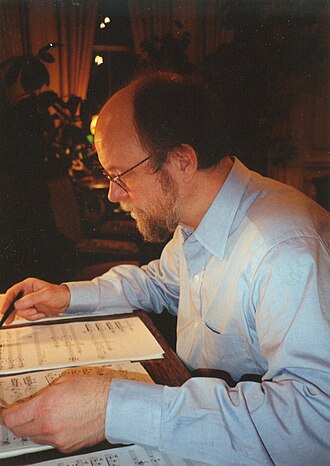
Charles Wuorinen
Charles Wuorinen (1938–2020) was an American composer, pianist, and educator recognized for his prolific contributions to contemporary classical music, particularly in the realms of serialism, modernist orchestration, and complex rhythmic structures. Wuorinen’s work encompasses orchestral, chamber, vocal, and operatic compositions, characterized by technical rigor, contrapuntal sophistication, and a commitment to the exploration of formal and structural innovation. He is widely regarded as one of the most influential American composers of the late twentieth and early twenty-first centuries.
Early Life and Education
Charles Peter Wuorinen was born on June 9, 1938, in New York City. A child prodigy, he began piano lessons at a young age and was composing music by early adolescence. He studied at the Trinity School in New York and later at Columbia University and Princeton University, where he studied composition under prominent figures including Otto Luening, Roger Sessions, and Milton Babbitt. Wuorinen also received private instruction from Luigi Dallapiccola in Florence, Italy, deepening his engagement with twelve-tone and serial techniques.
Career
Wuorinen’s compositional career began in earnest during the late 1950s and 1960s, and he quickly gained recognition for his technically demanding and intellectually rigorous works. He received commissions from major orchestras and ensembles, including the New York Philharmonic, the Boston Symphony Orchestra, and the Chamber Music Society of Lincoln Center. Wuorinen was also an active educator, teaching at institutions such as the Manhattan School of Music and Columbia University, where he influenced a generation of composers.
Throughout his career, Wuorinen maintained a commitment to modernist principles, combining serialist techniques with complex rhythmic structures, counterpoint, and orchestration. His works are noted for their formal clarity, structural ingenuity, and attention to instrumental color and timbre.
Major Works
Orchestral Music
Wuorinen composed extensively for orchestra, often employing serial techniques and intricate rhythmic structures. Notable works include:
Time’s Encomium (1969), an electronic composition that won the Pulitzer Prize for Music in 1970, exemplifying his early engagement with avant-garde technology.
Concerto for Amplified Violin and Orchestra (1971) and Percussion Symphony (1976), demonstrating his exploration of timbral extremes and virtuosity.
The Celestial Sphere (1981), a large-scale orchestral and choral work integrating serialist principles with cosmic and symbolic thematic material.
Chamber and Solo Music
Wuorinen’s chamber and solo works are marked by contrapuntal density and rhythmic complexity. Significant works include:
String Quartet No. 2 (1972), displaying rigorous serial procedures and contrapuntal interplay.
Piano Variations (1966), a virtuosic exploration of pianistic technique and formal transformation.
Trio for Flute, Bassoon, and Piano (1997), illustrating his ability to balance intricate textures with expressive clarity.
Vocal and Operatic Music
Wuorinen composed several operas and vocal works, often setting texts by modern poets and literary figures.
Haroun and the Sea of Stories (2004), based on Salman Rushdie’s novel, demonstrates his capacity to merge narrative structure with modernist musical language.
His Revelations (1962) and Rituals (1975) explore sacred texts and ceremonial forms through complex harmonic and rhythmic frameworks.
Electronic and Experimental Works
In addition to acoustic music, Wuorinen explored electronic music and multimedia composition, creating works that engaged with emerging technologies and experimental techniques.
Musical Style
Charles Wuorinen’s style is distinguished by:
Serialism and twelve-tone techniques: systematic pitch organization and motivic development.
Rhythmic complexity: use of polymeters, irregular rhythms, and temporal manipulation.
Counterpoint and structural rigor: intricate interweaving of independent lines and formal coherence.
Orchestration and timbral exploration: meticulous attention to instrumental color and ensemble balance.
Integration of modernist and experimental approaches: blending traditional compositional craft with avant-garde innovation.
His music is often intellectually challenging yet expressive, reflecting a commitment to the formal and structural possibilities of contemporary composition.
Influence and Legacy
Charles Wuorinen is regarded as a central figure in American contemporary music, noted for his contributions to serialism, modernist orchestration, and avant-garde compositional practice. His works have influenced numerous composers and performers, and he played a key role in shaping the landscape of postwar American classical music.
Wuorinen passed away on March 11, 2020, in New York City. His legacy endures through his extensive body of compositions, his influence as a teacher, and his role in advancing complex, intellectually rigorous musical thought in American and international contemporary music.