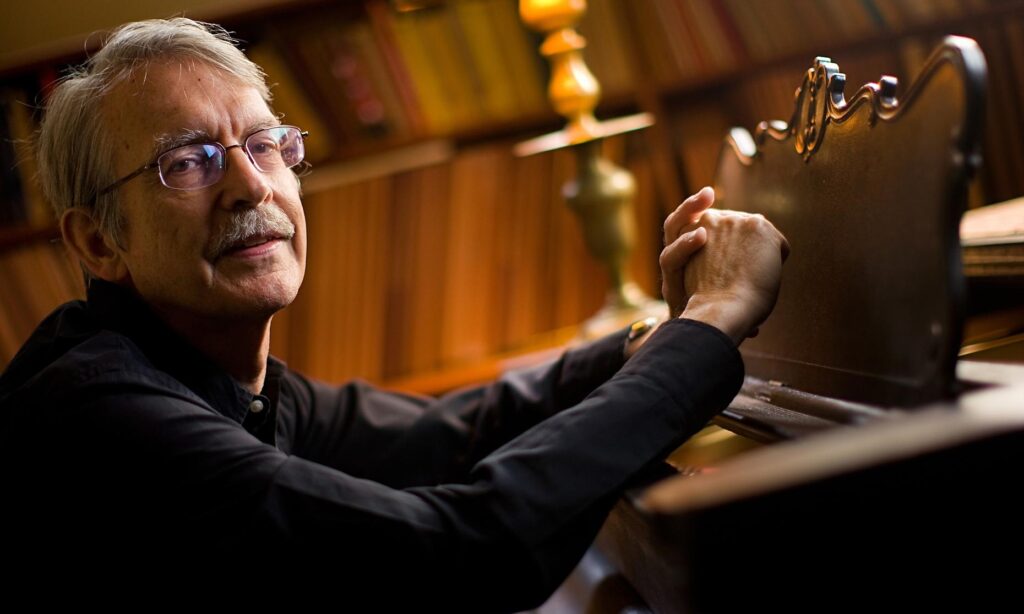
John Harbison
John Harbison (born 1938) is an American composer recognized for his diverse body of work encompassing symphonic, choral, operatic, chamber, and solo music. Harbison’s compositions are noted for their combination of lyricism, structural rigor, and expressive complexity, reflecting a distinctive blend of modernist and neo-Romantic idioms. He is widely regarded as one of the leading American composers of the late twentieth and early twenty-first centuries.
Early Life and Education
John Harbison was born on December 20, 1938, in Orange, New Jersey. He studied at Harvard University, where he was influenced by the American neoclassical tradition and contemporary European compositional techniques. He furthered his studies in Europe, studying with prominent composers and absorbing a wide range of stylistic approaches, including serialism, neo-classicism, and modernist experimentation.
Career and Musical Contributions
Harbison’s compositional career spans multiple genres, characterized by a balance between formal sophistication and expressive directness. His music integrates contrapuntal skill, rhythmic vitality, and tonal flexibility, enabling him to explore both traditional and innovative musical forms.
Symphonic and Orchestral Music
Harbison has composed extensively for orchestra, blending complex textures with clear formal structures:
Symphony No. 1 (1981) demonstrates his command of orchestral color and structural clarity.
Symphony No. 3 (1991) and Symphony No. 6 (2006) showcase his exploration of harmonic and rhythmic contrast, combining modernist techniques with lyrical elements.
Orchestral concertos, including works for violin, cello, and piano, emphasize virtuosic writing while maintaining expressive narrative.
Opera and Stage Works
Harbison has contributed significantly to opera, often drawing upon literary, historical, and philosophical subjects:
Winter’s Tale (2002), based on Shakespeare, illustrates his capacity for dramatic orchestration and vocal writing.
The Great Gatsby (1999) adapts F. Scott Fitzgerald’s novel into a work notable for lyrical vocal lines and nuanced orchestral support.
His operatic works demonstrate a careful integration of text, vocal expressivity, and orchestral texture.
Choral and Vocal Music
Choral and vocal music form a central part of Harbison’s oeuvre:
He has composed both sacred and secular works, ranging from motets and cantatas to song cycles for solo voices.
Works such as Requiem (1984) and various a cappella compositions combine contrapuntal rigor with tonal warmth, reflecting his interest in vocal expressivity and textual clarity.
Chamber and Solo Music
Harbison’s chamber and solo works exhibit structural precision and inventive instrumentation:
String quartets, wind ensembles, and piano works demonstrate a blend of modernist techniques, melodic lyricism, and rhythmic intricacy.
Solo compositions often explore technical challenges while maintaining expressive depth and clarity.
Style and Characteristics
Harbison’s music is distinguished by:
Lyricism and melodic clarity, creating immediacy and emotional resonance.
Harmonic versatility, combining tonal, modal, and chromatic languages.
Structural sophistication, with careful attention to form, counterpoint, and thematic development.
Integration of modernist and traditional elements, allowing accessibility without sacrificing complexity.
Expressive attention to text, particularly in vocal and choral works, ensuring that words and music are closely aligned.
Recognition and Influence
Harbison has received numerous awards and honors, including major commissions from American orchestras, opera companies, and festivals. He has served as a mentor to emerging composers and contributed to the development of contemporary American classical music through teaching, adjudication, and participation in professional organizations.
Legacy
John Harbison continues to be an influential figure in American music, known for his synthesis of modernist and traditional compositional techniques. His extensive body of work across multiple genres demonstrates a commitment to both innovation and communicative clarity, securing his position as a leading voice in contemporary classical composition.