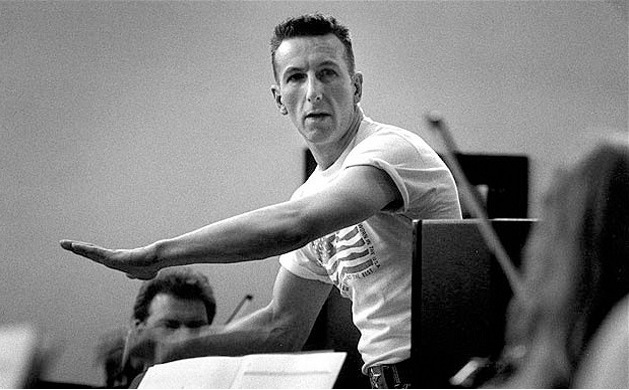
Steve Martland
Steve Martland (1954–2013) was a British composer whose work is closely associated with the rise of postminimalism, amplified ensembles, and the integration of classical composition with the energy and timbral vocabulary of popular and vernacular music. Known for his uncompromising aesthetic, socially engaged outlook, and advocacy for new music education, Martland became a distinctive voice in late twentieth-century British composition. His works, often performed by amplified groups and incorporating elements drawn from rock, jazz, and dance music, contributed to a redefinition of contemporary classical idioms in the United Kingdom.
Early Life and Education
Stephen John Martland was born on October 10, 1954, in Liverpool, England. He studied composition at the University of Liverpool and subsequently at the Royal Conservatory in The Hague, where he was mentored by Louis Andriessen. Andriessen’s influence—particularly his use of amplified instruments, driving rhythmic structures, and politically inflected works—played a foundational role in Martland’s development. This period solidified Martland’s commitment to a musical language that rejected traditional symphonic institutions in favor of alternative performance contexts.
Career and Musical Philosophy
Martland emerged in the 1980s as a leading figure in a new generation of composers who challenged the conventions of British contemporary music. Rejecting the orchestra as his primary medium, he preferred ensembles of amplified winds, keyboards, and percussion, creating a sonic environment closer to a hybrid of chamber music, rock performance, and industrial rhythm.
He was deeply committed to the idea that contemporary music should engage with broad audiences outside conventional classical venues. This conviction shaped both his compositional choices and his work as an educator and organizer, including longstanding collaborations with youth ensembles and his direction of the Steve Martland Band, an ensemble dedicated to performing his works.
Martland also held residencies and teaching positions at institutions such as the Bangor New Music Festival, the Britten-Pears School, and various educational programs across the UK.
Compositional Style
Martland’s music is characterized by:
Propulsive rhythmic structures, often borrowing from rock, funk, and jazz idioms.
Amplification, used not for stylistic effect alone but as an integral part of the timbral design.
Clear, often modal or static harmonic fields, reflecting both minimalist influences and a rejection of serialism.
Energetic ensemble writing, emphasizing unity, tightly coordinated gestures, and repetitive motivic development.
Political and social engagement, with several works addressing themes of violence, power, and resistance.
Unlike many contemporaries, Martland rarely used traditional orchestral forces; instead, he crafted a sound world defined by electric guitars, saxophones, pianos, and percussion in various amplified combinations.
Major Works
Instrumental and Ensemble Works
Martland’s catalog includes a number of prominent works for medium-sized amplified ensembles:
Shoulder to Shoulder (1988), a politically charged work originally conceived for dance-theatre contexts.
Drill (1987), with its militaristic rhythmic drive and large-scale structural tension, emblematic of Martland’s mature voice.
Dance Works (1993), written for the London Contemporary Dance Theatre, merging postminimalist processes with kinetic energy.
Patrol (1993), an intense, rhythm-driven composition for a large amplified ensemble.
Orchestral and Large-Scale Works
Although less frequent, Martland’s orchestral music includes pieces such as:
Crossing the Border (1989), which adapts his characteristic rhythmic language to the symphonic medium.
Beat the Retreat (1995), a reflection on themes of pacifism and military symbolism.
Choral and Vocal Works
Martland’s vocal output, though relatively limited, features works that emphasize text setting within his rhythmic and harmonic framework, including:
Street Songs (1994), written for children’s choir and ensemble, illustrating his commitment to educational and community-based music-making.
Educational and Social Engagement
Martland was an outspoken critic of elitism in contemporary music. He worked extensively with young musicians, developing educational initiatives aimed at expanding access to new music and encouraging creative participation. His involvement with youth music programs, composition workshops, and performances by nonprofessional ensembles reflected his belief that contemporary culture should be democratic and participatory.
Recognition and Legacy
Martland’s music has been performed throughout Europe and North America, often by ensembles specializing in contemporary music and amplified instrumentation. His influence is particularly notable among younger British composers and performers engaged in postminimalist and genre-blending practices.
Following his death on May 6, 2013, tributes emphasized his originality, his commitment to artistic integrity, and his substantial contribution to broadening the scope and reach of new music in Britain. His works continue to be performed by ensembles that share his belief in the vitality of contemporary music outside traditional institutions.
Conclusion
Steve Martland’s career represents a significant chapter in the evolution of late twentieth-century British composition. His fusion of classical, popular, and amplified idioms; his socially conscious artistic perspective; and his dedication to education and community engagement have secured his position as an influential and distinctive figure in modern music.