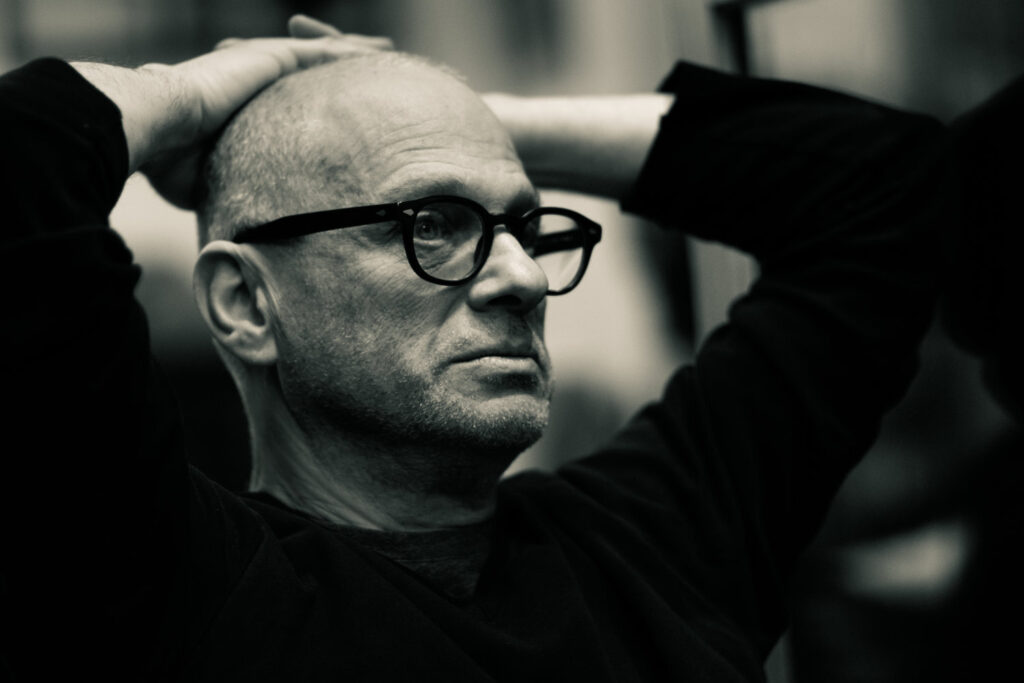
David Lang
David Lang (born 1957) is an American composer whose work occupies a central place in contemporary classical music, particularly within the postminimalist and avant-garde traditions. Known for his austere textures, conceptual rigor, and interdisciplinary collaborations, Lang has become one of the most influential figures in late twentieth- and early twenty-first-century American composition. His music spans opera, chamber ensemble, vocal works, orchestral writing, and multimedia performance. A co-founder of the influential collective Bang on a Can, Lang has been a major advocate for experimental and genre-crossing musical practices.
Early Life and Education
David Lang was born on January 8, 1957, in Los Angeles, California. He pursued an extensive musical education, earning degrees from Stanford University, the University of Iowa, and Yale University, where he studied with noted composers such as Jacob Druckman and Martin Bresnick. These formative years exposed him to a wide range of twentieth-century compositional techniques, from post-serialism to emerging minimalist currents, shaping the hybrid aesthetic that would characterize his later output.
Bang on a Can and Professional Development
In 1987 Lang co-founded Bang on a Can with fellow composers Michael Gordon and Julia Wolfe. The organization has since become a major force in the promotion of contemporary music, commissioning new works, fostering interdisciplinary collaboration, and presenting marathon concerts emphasizing stylistic diversity. Bang on a Can’s ensembles—including the Bang on a Can All-Stars—have provided a platform for Lang’s work and contributed to the broader acceptance of postminimalism within mainstream classical culture.
Lang’s involvement in this collective established him as a leading figure in American experimentalism, positioning his work at the intersection of classical composition, popular idioms, and performance art.
Compositional Style
Lang’s music is frequently described as postminimalist, though his aesthetic draws from a variety of sources. Hallmarks of his style include:
Economy of gesture and a focus on limited musical materials.
Textural clarity and an emphasis on repetition, gradual process, and subtle variation.
A quiet intensity, with works often exploring fragile, transparent sonorities.
Strong conceptual frameworks, in which formal design shapes the listener’s experience as much as sonic content.
Close attention to text, especially in vocal compositions, where meaning, fragmentation, and silence play crucial roles.
Lang’s works express a distinctive emotional restraint, often creating a sense of introspection or stillness that contrasts with the more rhythmically driven tendencies of other minimalists.
Major Works
Vocal and Choral Works
Lang has produced several prominent pieces for voice and chorus, many of which have achieved international recognition:
The Little Match Girl Passion (2007), a reimagining of the Hans Christian Andersen tale using the structural model of Bach’s passions. The work received the Pulitzer Prize for Music and has been widely performed for its intimate scale and spiritual resonance.
The Difficulty of Crossing a Field (1999), an experimental operatic work exploring disappearance and myth, in collaboration with playwright Mac Wellman.
love fail (2012), a music-theatre meditation on the Tristan and Isolde myth, blending medieval and contemporary sources.
Orchestral and Chamber Works
Lang’s instrumental music reflects his interest in spare textures and innovative sonic combinations. Representative works include:
man made (2013), composed for So Percussion and orchestra, integrating found objects and unconventional performance techniques.
this was written by hand (2003), a meditative work for solo piano exploring repetition and decay.
pierced (2007), for cello ensemble and strings, demonstrating his characteristic mixture of lyricism and structural severity.
Film and Interdisciplinary Projects
Lang has composed for film and collaborated frequently with choreographers, visual artists, and theatre directors. His score for Paolo Sorrentino’s film Youth (2015) brought his music to new audiences, while projects such as just (after song of songs) highlight his interest in multimedia contexts and the expressive possibilities of text.
Recognition and Awards
David Lang has received numerous honors throughout his career. In addition to the Pulitzer Prize, he has been recognized with awards from arts councils, academic institutions, and international festivals. His music is performed by leading ensembles and has been featured in major venues and festivals worldwide.
Influence and Legacy
Lang’s role as both composer and cultural organizer has significantly shaped the landscape of American contemporary music. Through Bang on a Can, he has helped foster a community that challenges traditional boundaries between genres and forms. His compositions—characterized by conceptual depth, emotional nuance, and structural clarity—continue to influence younger generations of composers, particularly those interested in postminimalism and interdisciplinary practice.
Conclusion
David Lang stands as a major figure in modern music, celebrated for his innovative approach to texture, form, and narrative. His contributions range from intimate choral works to large-scale collaborative projects, each reflecting a deep commitment to expanding the expressive scope of contemporary composition. Through both his individual output and his institutional leadership, Lang has had a lasting impact on the development of twenty-first-century musical culture.